
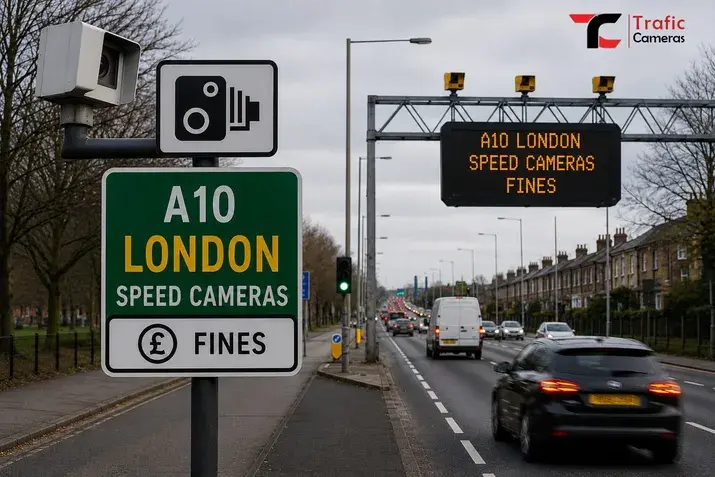
The A10 London speed cameras fines are an important concern for drivers using one of London's busiest routes. The A10 passes through areas including Enfield,
The A10 London speed cameras fines are an important concern for drivers using one of London's busiest routes. The A10 passes through areas including Enfield, Edmonton, Tottenham and Hackney, with speed enforcement particularly prominent along the Enfield section.
Drivers can encounter average-speed camera systems and other forms of enforcement on the route. Understanding how these cameras work, what penalties may apply and what happens after a camera detects speeding can help motorists avoid unnecessary fines and penalty points.
Drivers can also check live UK traffic cameras before travelling to see current road conditions and available camera coverage.
What Speed Cameras Are on the A10?
The A10 uses average-speed camera enforcement across important sections of the route. This is different from a traditional fixed camera that measures a vehicle's speed at one particular point.
Average-speed cameras monitor a vehicle between two or more camera points. The system records the time taken to travel between those points and calculates the vehicle's average speed.
This means slowing down only when approaching a camera is not a reliable way to avoid enforcement. Drivers need to maintain a legal speed throughout the monitored section.
The original average-speed camera system between Bullsmoor Lane and Southbury Road was completed in March 2020. In August 2025, the system was extended south from Southbury Road towards the A406.
A10 Average Speed Camera Extension
The extension was introduced by Transport for London, the Metropolitan Police and Enfield Council as part of wider measures to reduce road danger and tackle speeding on the A10.
The additional average-speed cameras cover the southern section between Southbury Road and the A406. Enfield Council said the extension was intended to create a more joined-up enforcement approach along the route.
Because camera coverage can change, drivers should always follow the current road signs rather than relying on information from an older journey.
For current road conditions, motorists can use the Traffic Cameras live map before starting their journey.
How Much Are A10 London Speed Cameras Fines?
Speeding penalties on the A10 follow the national rules that apply across England and Wales.
A standard Fixed Penalty Notice for speeding is normally:
- £100 fine
- 3 penalty points
However, not every speeding offence receives the same penalty. Depending on the circumstances, an eligible driver may be offered a speed awareness course, while more serious offences can be referred to court.
The amount of the penalty depends on factors such as the speed recorded, the applicable speed limit and how the offence is dealt with.
Can an A10 Speeding Fine Be More Than £100?
Yes. More serious speeding offences can result in a court prosecution. A court can impose a larger fine, additional penalty points or a driving disqualification depending on the circumstances.
For this reason, drivers should not assume that every A10 camera offence will result in the standard £100 penalty.
What Happens After an A10 Speed Camera Catches You?
Being detected by an A10 speed camera does not normally mean that a fine arrives immediately.
The registered keeper of the vehicle will generally receive a Notice of Intended Prosecution (NIP) if the police intend to prosecute for a camera-detected speeding offence. The registered keeper may also receive a Section 172 notice requesting information about who was driving.
The general process is:
- The camera detects an alleged speeding offence.
- The registered keeper receives the relevant notice.
- The driver details are provided.
- The police decide what action is appropriate.
- The driver may receive a fixed penalty, be offered a speed awareness course or be prosecuted in court.
Drivers should respond to official notices within the stated deadlines.
Do A10 Speed Cameras Add Points to Your Licence?
Yes,a speeding offence detected by an enforcement camera can result in penalty points.
A standard Fixed Penalty Notice normally carries 3 penalty points. More serious offences dealt with through the courts can result in additional points or a driving ban.
The type of camera does not make the offence less serious. Whether an offence is detected by an average-speed camera or another enforcement camera, the consequences depend on the circumstances of the speeding offence.
Where Are the A10 Speed Cameras?
A significant area of speed-camera enforcement is the A10 through Enfield.
The original average-speed camera section covered the area between Bullsmoor Lane and Southbury Road. The system was later extended south from Southbury Road to the A406 in 2025.
TrafficCameras.info also provides individual A10 camera information. For example, motorists can check the A10 Great Cambridge Road camera for current camera and road information.
Why Should Drivers Check Current Camera Information?
Camera locations, enforcement arrangements and road conditions can change. Relying on an old list of camera locations may therefore give drivers incomplete information.
Checking current traffic information before travelling can also help motorists identify congestion, road hazards and changing conditions.
The Traffic Cameras live map allows users to plan a route and view relevant cameras and approved hazards. Drivers looking for other roads can browse the UK roads directory to find available camera coverage.
Are A10 Average-Speed Cameras Different From Fixed Cameras?
Yes. A fixed speed camera generally measures speed at a particular location. An average-speed camera system calculates a vehicle's average speed between camera points.
This makes average-speed enforcement different from a single-point speed check.
Drivers should therefore avoid the common mistake of slowing down near one camera and then accelerating again. If they are travelling through an average-speed zone, their speed is considered across the monitored section.
Maintaining a consistent speed within the posted limit is the safest approach.
Can You Avoid an A10 Speeding Fine?
The best way to avoid an A10 speeding fine is to avoid exceeding the posted speed limit.
Drivers using the route should:
- Check the current speed limit.
- Watch for average-speed camera signs.
- Maintain a consistent legal speed.
- Avoid accelerating between camera points.
- Allow additional journey time during congestion.
- Check road conditions before travelling.
- Respond promptly to any official speeding notice.
Drivers should also remember that the speed limit is the legal maximum, not a target that must be reached.
Before leaving, motorists can use Traffic Cameras.info to check available traffic cameras and plan their route.
Why Has Speed Enforcement Increased on the A10?
Speed enforcement on the A10 has increased because of concerns about speeding, road danger and antisocial driving.
TfL has worked with the Metropolitan Police and Enfield Council on measures designed to improve safety on the route. The average-speed camera system was extended in 2025 as part of these measures.
The purpose of speed cameras is not simply to issue fines. Enforcement is intended to encourage drivers to comply with speed limits and reduce dangerous driving.
For regular A10 users, following the posted speed limit throughout the journey is the simplest way to avoid enforcement action.
Check A10 Traffic Before Your Journey
Speed cameras are only one part of driving conditions on the A10. Congestion, roadworks, accidents and other hazards can also affect journey times.
Before travelling, drivers can use the A10 traffic camera information and the Traffic Cameras live map to check available information.
The live map can also help drivers plan a route and see cameras and reported hazards along their journey.
For wider UK coverage, the Traffic Cameras roads directory provides access to camera information across different motorways and A-roads.
Final Thoughts on A10 London Speed Cameras Fines
Understanding A10 London speed cameras fines can help drivers know what to expect when using this busy London route.
A standard speeding Fixed Penalty Notice is normally £100 and 3 penalty points, while some drivers may be eligible for a speed awareness course. More serious offences can be dealt with by a court and may result in larger fines, additional points or disqualification.
The A10's average-speed camera coverage has also expanded, with the system extended from Southbury Road towards the A406 in 2025.
The safest approach is straightforward: follow the posted speed limit, pay attention to average-speed camera zones and check current road conditions before travelling.
For live road information and camera coverage across the UK, drivers can visit TrafficCameras.info.
FAQs
How much is an A10 speeding fine in London?
A standard speeding Fixed Penalty Notice is normally £100 and carries 3 penalty points. Some eligible drivers may instead be offered a speed awareness course, while serious cases can go to court.
Does the A10 have average-speed cameras?
Yes. Average-speed camera enforcement operates on sections of the A10. The system originally covered the area between Bullsmoor Lane and Southbury Road and was extended south towards the A406 in 2025.
Can I avoid an A10 speeding ticket by slowing down at the camera?
No. Average-speed cameras calculate speed across a monitored section rather than simply checking speed at one camera point. Drivers should maintain a legal speed throughout the zone.
How long does an A10 speeding ticket take to arrive?
For a camera-detected offence, the registered keeper will generally receive a Notice of Intended Prosecution within the applicable legal timeframe. The notice will provide instructions about the next steps.
Do A10 speed camera offences give you penalty points?
Yes. A standard speeding Fixed Penalty Notice normally carries 3 penalty points. More serious offences can result in additional points or disqualification.
Where does the A10 average-speed camera system cover?
The original system covered Bullsmoor Lane to Southbury Road. In 2025, the system was extended south from Southbury Road to the A406.
Are average-speed cameras the same as fixed speed cameras?
No. Fixed cameras generally measure speed at one location, while average-speed systems calculate a vehicle's average speed between camera points.In August