
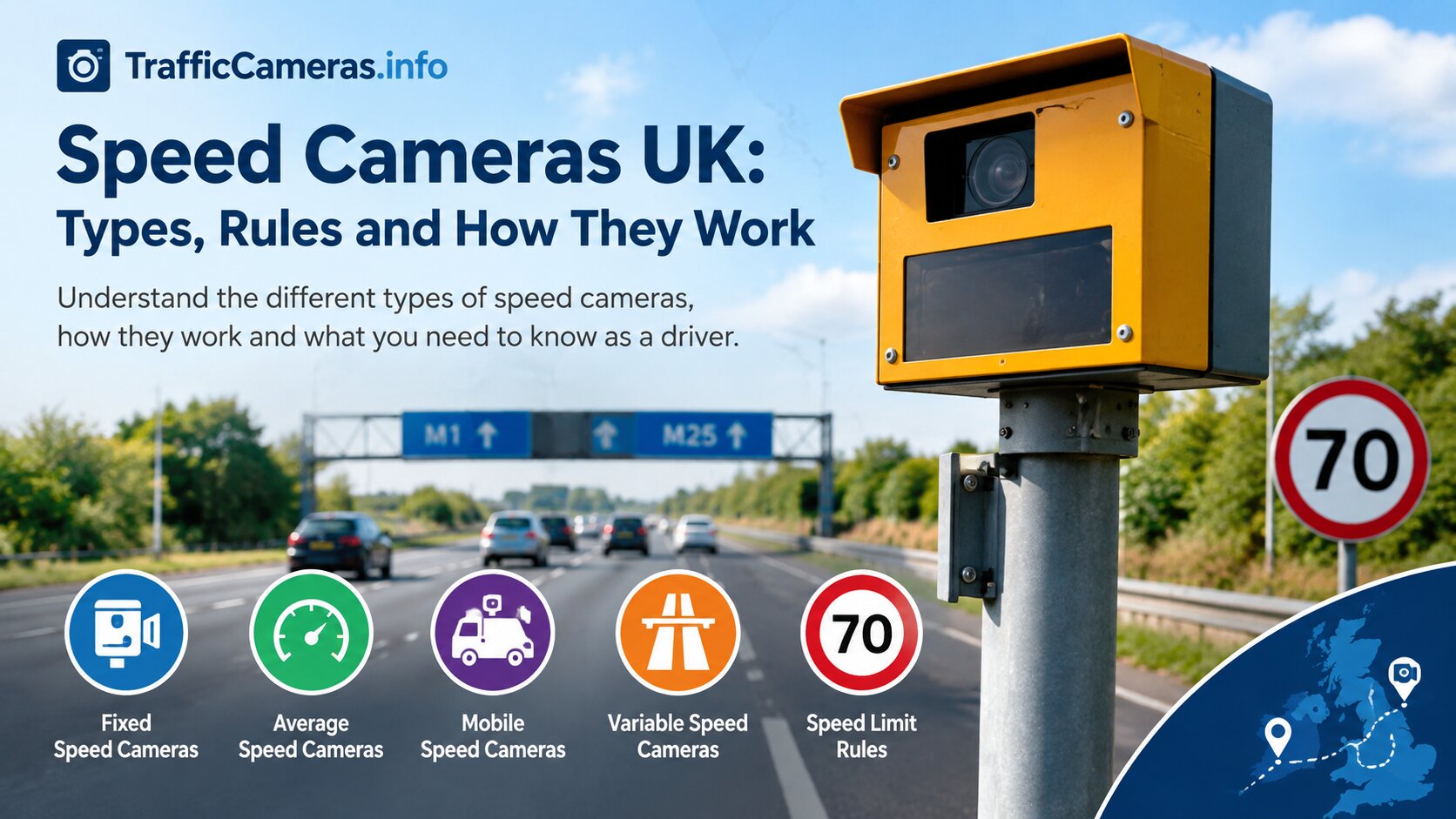
Learn how UK speed cameras work, including fixed, mobile and average speed cameras, speed limits, enforcement and key rules for drivers.
Speed cameras are a common part of the UK road network and are used to help enforce speed limits and improve road safety. You may see fixed cameras beside a road, average speed cameras across a longer section, or mobile camera vehicles operating from different locations.
However, not every roadside camera is a speed camera. Some cameras are used to monitor traffic conditions, while others can enforce red-light or other road traffic offences.
Understanding the different types of speed cameras in the UK can help drivers understand what they are looking at and why cameras are installed on particular roads.
What Are Speed Cameras in the UK?
A speed camera is an enforcement device designed to detect vehicles travelling above an applicable speed limit. Depending on the system, it can measure a vehicle's speed at a particular location or calculate its average speed over a defined distance.
Speed enforcement equipment must meet technical requirements. The Home Office's current camera handbook covers type approval procedures for speedmeters and other road traffic enforcement cameras used in Great Britain.
It is also important to understand the difference between a speed camera and a normal traffic camera. A traffic camera may provide a view of current road conditions without being used to issue speeding penalties.
If you want to check current road conditions rather than enforcement cameras, you can use the live traffic cameras on TrafficCameras.info to see available camera views before travelling.
Types of Speed Cameras in the UK
There are several types of speed enforcement cameras used across UK roads. They do not all measure speed in the same way.
Fixed Speed Cameras
Fixed speed cameras are permanently installed at particular locations. They are often positioned on roads where speed management is considered important, including locations with a history of collisions or other road safety concerns.
These cameras can measure the speed of vehicles passing a specific point. Depending on the equipment, the system may use radar, sensors or other approved measurement methods.
The appearance of a camera alone does not always tell you exactly what it is designed to enforce. Some modern systems can perform more than one enforcement function.
Average Speed Cameras
Average speed cameras work differently from a traditional fixed camera.
Instead of measuring your speed at one point, an average speed system uses cameras positioned at different points along a route. The system records vehicles at the relevant points and calculates the average speed over the measured distance.
The Home Office has confirmed that automatic distance/time speedmeters require multiple camera units to calculate average speed over an enforcement zone.
This means slowing down only when passing one camera is not an effective way to comply with an average speed limit. Drivers need to maintain the applicable speed limit throughout the monitored section.
Average speed cameras are particularly relevant on longer roadworks sections and some motorway and major A-road routes.
Mobile Speed Cameras
Mobile speed cameras can be deployed at different locations rather than remaining permanently installed.
They may operate from marked or otherwise authorised vehicles and can be used by enforcement authorities in different road environments.
Because mobile enforcement can take place at changing locations, drivers should not rely on knowing where permanent cameras are located. The safest approach is to follow the posted speed limit throughout the journey.
Variable Speed Cameras
Variable speed limits are used on some motorways and major roads. The applicable limit can change depending on traffic conditions, incidents, roadworks or other circumstances.
Where a variable limit is displayed, drivers must follow the current signed limit rather than assuming the normal national speed limit applies.
This is particularly important when travelling on busy motorway routes. For example, you can use the M1 traffic cameras to check current road conditions before travelling along the M1.
What Is the UK National Speed Limit?
The national speed limit depends on the type of road and vehicle.
For cars and motorcycles, the standard limits are generally:
- 30 mph in built-up areas where no other limit applies
- 60 mph on single carriageways
- 70 mph on dual carriageways
- 70 mph on motorways
However, local authorities can set different limits, and signed limits can be lower than the national limit. Wales also has different rules for certain built-up roads, where a 20 mph limit applies in relevant areas.
Always follow the speed limit shown on road signs. The national speed limit is not automatically the correct limit for every road.
How Do Speed Cameras Detect Speeding?
Different camera systems use different technologies.
A speed enforcement system may use radar, laser, distance-and-time measurement, sensors or photographic evidence. Approved systems have technical requirements for measurement accuracy and verification.
For example, the Home Office handbook specifies requirements for independent secondary speed measurement for approved enforcement systems.
Once an alleged offence is detected, the evidence can be processed by the relevant enforcement authority or police force.
This is different from a live traffic camera, which is generally used to provide information about traffic conditions rather than automatically issue speeding penalties.
Are Traffic Cameras the Same as Speed Cameras?
No. This is one of the most common points of confusion.
A traffic camera can show current road conditions, congestion, incidents or traffic flow. A speed camera is designed for speed enforcement.
For example, TrafficCameras.info provides live camera coverage across many UK routes. Its roads directory includes motorway and A-road routes with available camera coverage.
You can use these cameras to check what a route looks like before travelling, but you should not assume that a camera shown on a traffic-camera website is a speed enforcement camera.
This distinction is especially useful on busy motorways. For example, the M25 traffic cameras page provides live route camera coverage, while speed enforcement is a separate function.
What Happens If a Speed Camera Catches You?
If a camera detects an alleged speeding offence, the registered keeper may receive a Notice of Intended Prosecution and a Section 172 notice.
GOV.UK states that the Notice of Intended Prosecution and Section 172 notice should generally be sent within 14 days of the vehicle being caught speeding. The Section 172 notice must be returned within 28 days identifying the driver.
The minimum penalty for speeding is currently £100 and 3 penalty points, although more serious cases can result in different penalties and may go to court.
The exact outcome depends on the circumstances and enforcement process, so drivers should use official guidance rather than relying on common internet claims about camera penalties.
Is There a 10% Speed Camera Rule?
You may have heard that UK speed cameras allow drivers to travel 10% over the limit, sometimes with an additional 2 mph.
This should not be treated as a legal allowance.
The speed limit is the maximum legal speed for the road and vehicle concerned. GOV.UK does not state that drivers are legally permitted to exceed it by 10% or by any fixed amount.
There are technical accuracy requirements for approved enforcement equipment, and enforcement guidance can affect how police forces operate speed enforcement. These technical or operational thresholds should not be confused with permission to speed.
The safest approach is simple: stay within the signed speed limit.
Why Check Traffic Cameras Before Your Journey?
Speed cameras and traffic cameras serve different purposes, but both are relevant to safer journey planning.
Before a long journey, checking live camera images can help you understand whether traffic is moving normally or whether congestion has developed.
For example, drivers travelling on the M62 can use the M62 traffic cameras to check available views along the route. The site also provides camera coverage for many other motorways and A-roads.
A camera image should not be considered a complete picture of road conditions. Weather, roadworks, incidents and traffic can change quickly. Combining camera images with current traffic information can give you a better understanding of what may be happening on your route.
Speed Cameras and Safer Driving
Speed cameras are only one part of the wider road safety system. Drivers should always pay attention to road signs, changing speed limits, weather, traffic conditions and other road users.
This is particularly important on motorways and major A-roads where conditions can change quickly.
If you are planning a journey, check the relevant UK traffic cameras before setting off and use the available route information to understand current conditions.
Remember that a clear camera image does not guarantee that the road will remain clear throughout your journey. Conditions can change within minutes.
Final Thoughts
Speed cameras in the UK come in several forms, including fixed, mobile and average speed systems. Their technology and operation can differ, but the basic rule for drivers remains the same: follow the applicable speed limit and pay attention to road signs.
It is also important to understand the difference between speed enforcement cameras and live traffic cameras. A live camera can help you check current road conditions, while a speed camera is designed to enforce speed limits.
Before travelling, you can use TrafficCameras.info to check live traffic cameras and view available camera coverage across motorways and A-roads. This can help you get a better picture of current conditions before you begin your journey.
FAQs
1. What are the main types of speed cameras in the UK?
The main types include fixed speed cameras, average speed cameras, mobile speed cameras and systems used alongside variable speed limits. Different systems use different methods to measure vehicle speed.
2. Are traffic cameras and speed cameras the same?
No. Traffic cameras can provide views of current road
conditions, while speed cameras are designed for speed enforcement. A camera
shown on a live traffic-camera website is not necessarily a speed enforcement
camera.
3. What is the minimum speeding penalty in the UK?
The minimum penalty for speeding is currently £100 and 3
penalty points. More serious offences can result in different penalties or
court proceedings.
4. Do average speed cameras measure your speed at one
point?
No. Average speed cameras calculate a vehicle's average
speed between two or more camera points over a measured distance.
5. Can I use traffic cameras to check road conditions?
Yes. TrafficCameras.info provides camera coverage across many UK motorways and A-roads. You can use the live traffic map and individual route pages to check available camera views before travelling.