
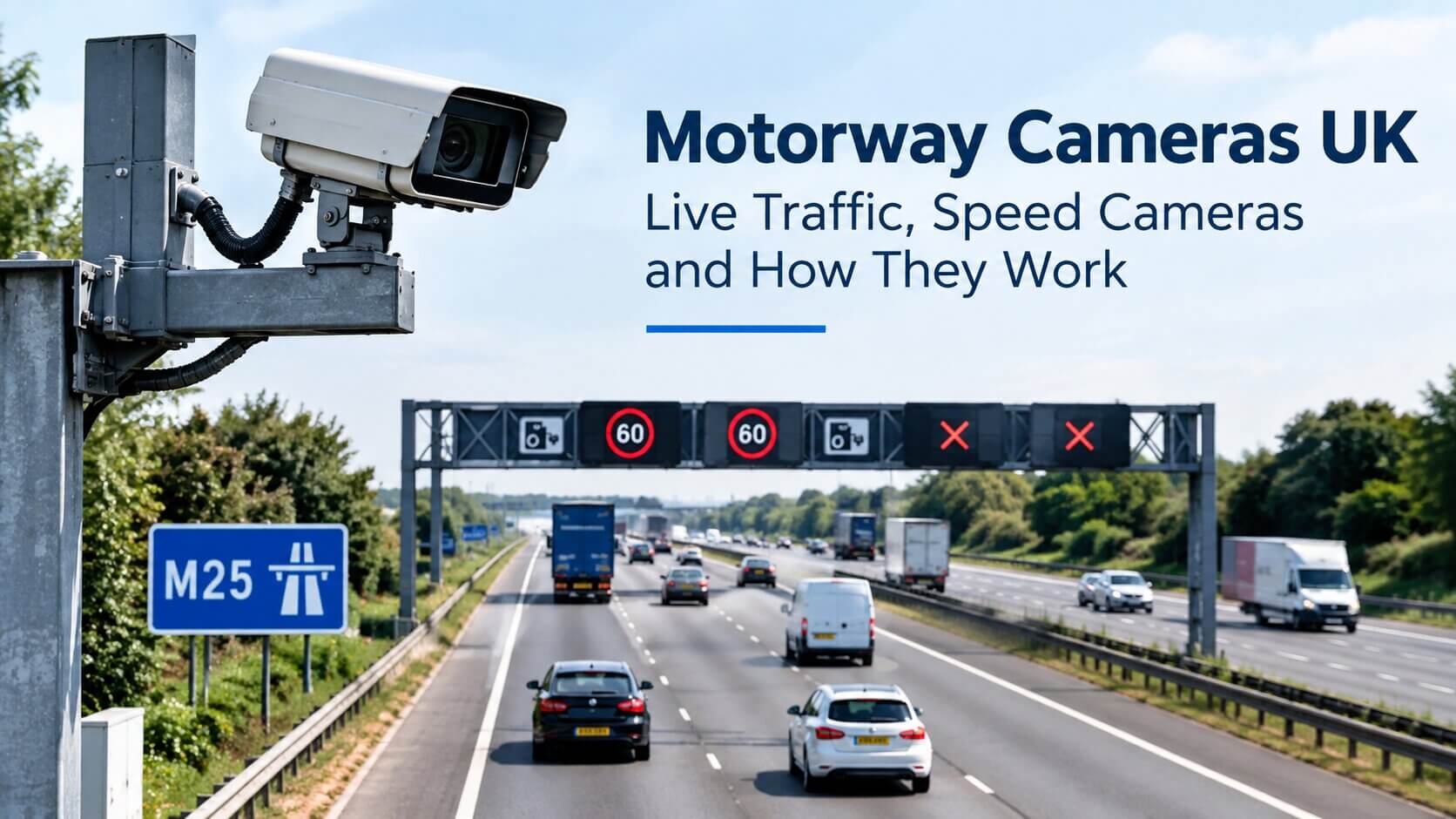
Motorway cameras in the UK are used for several purposes,
including monitoring traffic, detecting incidents, managing congestion and
enforcing certain road rules. For drivers, motorway cameras UK services
can also be useful for checking road conditions before starting a journey.
Not every camera on a motorway is a speed camera. Some are
used for traffic monitoring, while others support variable speed limits, lane
management or enforcement.
In this guide, we explain the main types of motorway cameras, how speed enforcement works and how you can check live motorway cameras before travelling.
What Are Motorway Cameras in the UK?
Motorway cameras are part of the technology used to monitor
and manage major UK roads. Depending on their purpose, cameras can help
operators monitor traffic flow, identify incidents, check congestion and
support enforcement.
Modern motorway systems can include CCTV, speed enforcement
cameras, electronic signs and other traffic-monitoring technology.
For drivers, the most useful feature is the ability to check
camera images before travelling. A camera can provide a quick view of traffic
conditions at a particular location, although it should always be considered
alongside other road information.
What Are Motorway Cameras Used For?
Motorway cameras can be used for:
- Monitoring
traffic flow
- Checking
congestion
- Supporting
incident management
- Monitoring
road conditions
- Supporting
variable speed limits
- Speed
enforcement
- Monitoring
lane restrictions
- Helping
traffic control centres respond to incidents
You can browse the UK Roads Traffic Cameras directory
to find available motorway routes and camera coverage.
Are All Motorway Cameras Speed Cameras?
No. This is an important distinction. Some cameras are used mainly for CCTV and traffic monitoring, while others can be used for speed or other enforcement.
TrafficCameras.info's guide to smart
motorway camera myths explains why not every camera seen on a motorway
should be assumed to be a speed camera.
Types of Motorway Cameras in the UK
Different camera systems can have different jobs.
Understanding the difference can help drivers better interpret what they see on
motorways.
Motorway CCTV Cameras
CCTV cameras help monitor traffic and incidents. They can
provide operators with a view of congestion, breakdowns, collisions and other
problems affecting the road.
For drivers, publicly available camera images can provide a
useful snapshot of conditions before travelling.
Motorway Speed Cameras
Some motorway cameras are used for speed enforcement.
This is particularly relevant on sections where variable
mandatory speed limits are displayed on overhead signs. If a lower speed limit
is displayed in a red circle, drivers must follow that limit.
It is important not to assume that every camera beside a
motorway is measuring speed. Camera purpose varies by location and system.
For more information about different speed camera types, see
Speed
Cameras UK: Types, Rules and How They Work.
Smart Motorway Cameras
Smart motorways use several technologies to monitor and
manage traffic. These can include:
- CCTV
cameras
- Variable
speed limits
- Speed
enforcement cameras
- Electronic
signs
- Red X
lane signals
- Stopped
Vehicle Detection
- Traffic-flow
monitoring systems
This means smart motorway cameras can have different
functions. Some help detect traffic conditions or incidents, while others
support enforcement.
Read our detailed guide to Smart
Motorway Camera Myths: What's Actually True for more information.
Red X Enforcement
Cameras
A Red X above a motorway lane means that the lane is closed.
Drivers should not continue using a lane displaying a Red X.
Some enforcement systems can detect vehicles that ignore
lane closure signals. This is one reason why drivers should always pay
attention to overhead motorway signs, rather than focusing only on the cameras
themselves.
How Do Motorway Speed Cameras Work?
Motorway speed enforcement can work differently depending on
the camera system and road layout.
On roads using variable mandatory speed limits, overhead
signs can change the applicable limit according to traffic conditions,
incidents or other circumstances.
The important point for drivers is to follow the current
displayed speed limit.
How Variable Speed Limits Affect Camera
Enforcement
Variable speed limits are commonly associated with managed
and smart motorway sections.
For example, an overhead sign may reduce the limit from 70
mph to 60, 50 or 40 mph. Once a mandatory lower limit is displayed, drivers are
expected to follow it.
Drivers should therefore pay attention to the signs above
each lane and not assume that the national motorway speed limit applies
throughout the entire journey.
Can Motorway Cameras Detect Speeding?
Yes, some motorway cameras are used for speed enforcement.
However, this does not mean every visible motorway camera
checks the speed of passing vehicles. CCTV and traffic-monitoring cameras have
different purposes.
The simplest approach is to follow the speed shown on
motorway signs and adjust your speed when the limit changes.
Do Motorway Cameras Work When the Speed Limit Changes?
Variable speed camera systems are designed to operate
alongside variable speed limits. There have also been reported technical issues
involving some variable-speed camera systems in the past, which shows why
drivers should rely on the displayed road signs rather than trying to work out
whether a particular camera is operating.
Following the current limit is the safest approach
regardless of whether a camera is visible.
How to Check Live Motorway Cameras Before
Your Journey
Checking live motorway cameras before travelling can
help you understand current conditions on important parts of your route.
TrafficCameras.info allows drivers to browse motorway
cameras by road and use the live map to inspect camera locations.
Check Motorway Traffic Cameras by Road
If you know which motorway you will be using, you can go
directly to its road page.
TrafficCameras.info currently lists major routes including
the M1, M2, M3, M4, M5, M6, M11, M20, M23, M25, M40, M42 and several others in
its motorway roads directory.
Some useful examples include:
- M1 Traffic Cameras
— useful for checking conditions along the M1.
- M4 Traffic Cameras
— check camera coverage along the M4.
- M6 Traffic Cameras
— check available M6 camera locations.
- M25 Traffic Cameras
— useful for checking conditions around the M25.
- M62 Traffic Cameras
— check M62 traffic, cameras and route conditions.
Camera images can be particularly useful when combined with
information about roadworks, incidents, weather and traffic delays.
Use the TrafficCameras.info Live Map
The TrafficCameras.info
Live Map allows users to filter camera locations by road type,
including motorways and A-roads. It also provides route planning, allowing
users to enter two UK postcodes and view cameras and approved hazards along the
route.
This makes the map useful for checking a motorway journey
before setting off.
Check Cameras Along Your Route
You do not need to check every camera in the UK. Focus on
the motorway sections you will actually use.
A simple process is:
- Identify
the main motorway sections on your route.
- Open
the relevant road camera page.
- Check
available camera images.
- Look
for congestion or visible incidents.
- Check
other official traffic information.
- Review
the route again if conditions are changing.
Always check camera information before driving rather than
using a phone or website while operating a vehicle.
Which UK Motorways Have Traffic Cameras?
Traffic camera coverage varies by road and location.
TrafficCameras.info's motorway directory currently includes a wide range of
major M-roads.
M25 Motorway Cameras: The M25 is a major orbital
motorway around London, so traffic conditions can change quickly, particularly
around busy junctions.
M1 Motorway Cameras: The M1 is a major north-south
motorway connecting London and Leeds.
M4 Motorway Cameras: The M4 is an important east-west
route connecting London with western England and South Wales.
M6 Motorway Cameras: The M6 is one of the UK's main
long-distance motorway routes.
Other Major Motorway Cameras
TrafficCameras.info also covers routes such as the M2, M3,
M5, M11, M20, M23, M40, M42, M48, M49 and M62.
Motorway Cameras vs Traffic Cameras:
What's the Difference?
The terms motorway cameras, traffic cameras, CCTV cameras
and speed cameras are often used together, but they can refer to different
systems.
Traffic Cameras
Traffic cameras are primarily used to monitor traffic,
congestion and incidents.
They can provide useful visual information about current
road conditions.
Speed Enforcement
Cameras
Speed enforcement cameras are designed to detect vehicles
exceeding an applicable speed limit.
On managed motorway sections, enforcement can also relate to
variable mandatory speed limits.
Why the Difference Matters
A camera beside a motorway does not automatically mean that
it is a speed camera.
Some systems monitor traffic, while others support
enforcement or motorway management. Drivers should therefore focus on the road
signs and current speed limits rather than trying to identify the purpose of
every camera they pass.
How to Use Motorway Cameras When Planning
a Journey
Motorway cameras are most useful when combined with other
journey information.
Check Before Leaving
Check your main motorway route before starting your journey.
Look at busy sections, major junctions and any available camera images.
Check Major Junctions and Congestion Points
Congestion can build quickly around busy junctions. Checking
a camera close to the area you are approaching can give you a better idea of
current conditions.
Combine Cameras With
Other Road Information
A camera only shows what is happening at a particular
location. It may not explain why traffic is slow or how long a delay will last.
For a better picture, combine camera images with:
- Traffic
alerts
- Roadworks
- Road
closures
- Weather
information
- Incident
reports
- Variable
speed limits
- Official
motorway signs
Check Motorway Cameras Before You Travel
Motorway cameras help provide information about traffic
conditions, incidents and, in some cases, enforcement. They can be particularly
useful for drivers who want to check a route before starting a long journey.
If you are travelling on the M1, M4, M6, M25, M62 or another
major motorway, check the available camera information before you leave.
Use the TrafficCameras.info to view motorway camera locations and check route conditions
before your journey.
Remember that camera images are only one part of journey
planning. Always follow the speed limits, motorway signs and current road
instructions while driving.
FAQs
Are there cameras on every UK motorway?
Camera coverage varies between roads and locations. Major
motorways have different types of monitoring and enforcement technology, but
individual sections can have different camera coverage.
Do all motorway cameras catch speeding?
No. Some are used for traffic monitoring or incident
detection, while others can support speed enforcement.
Do motorway cameras flash?
Not all motorway enforcement systems use a visible flash.
The absence of a flash should not be taken as proof that a camera has not
detected a vehicle.
Can I check motorway cameras live?
Yes. You can use the TrafficCameras.info Live Map
to explore available UK traffic camera locations and filter for motorways.
Are smart motorway cameras always active?
Different camera systems have different purposes and
operating arrangements. Drivers should always follow the current speed limits,
lane signals and other instructions displayed on the motorway.
Can I see motorway cameras before travelling?
Yes. Checking available camera images before leaving can
help you understand current conditions along your route.
Where can I find UK motorway camera locations?
The TrafficCameras.info Roads Directory provides a list of motorway routes and available camera coverage.